
How to Choose the Ri...
How to Choose the Right Domain Name?
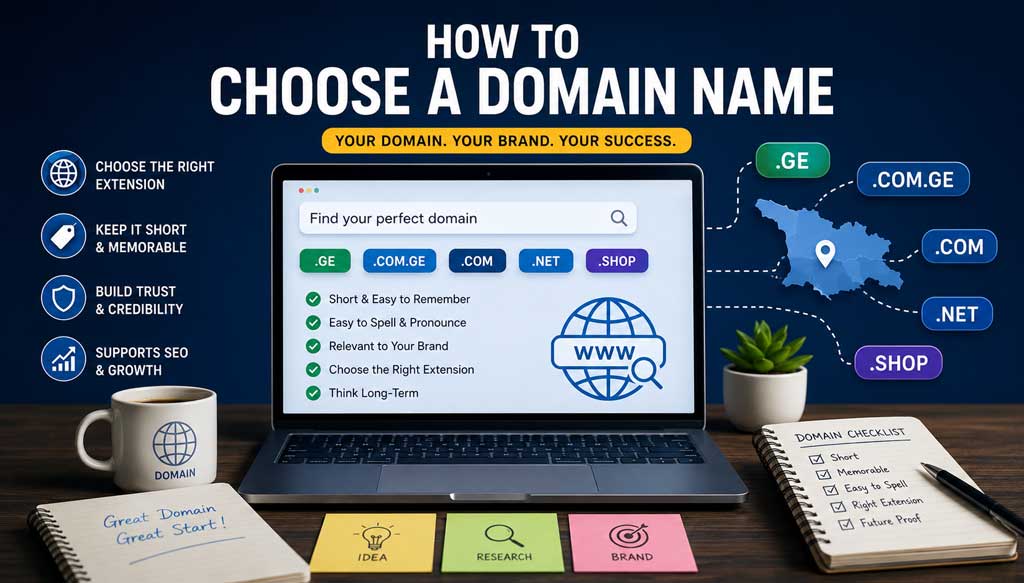
How to Choose the Right Domain Name?
How to Choose the Right Domain Name
Choosing a domain name is one of the first and most important decisions when creating a website. Whether you’re launching a personal blog, an online store, a startup, or a corporate website, your domain becomes your digital identity. It is the address customers type into their browser, the name they remember, and often the first thing they associate with your brand.
A well-chosen domain name can strengthen your business image, improve brand recognition, and make your website easier to find and remember. On the other hand, a confusing or poorly selected domain may reduce customer trust, create unnecessary marketing challenges, and even limit your future growth.
Many business owners spend weeks choosing a company name but only a few minutes selecting a domain. In reality, both decisions deserve equal attention because your domain will represent your business online for many years.
In this guide, you’ll learn how domain names work, how to choose the right one for your business, the differences between Georgian and international domain extensions, and the common mistakes you should avoid before registering your website.
What Is a Domain Name?
A domain name is the unique address people use to access your website on the Internet. Instead of remembering a complex numerical IP address, users simply type an easy-to-read name into their browser.
For example:
is much easier to remember than a sequence of numbers like:
192.168.xxx.xxx
Every website on the Internet has an IP address, but domain names make websites accessible and user-friendly.
Think of a domain as your business address in the digital world. Just as customers need a physical address to find a store, they need a domain name to find your website.
Besides helping visitors reach your site, a domain also plays an important role in branding. A professional, memorable domain instantly creates a stronger first impression and increases credibility.
Second-Level Domain
Every domain consists of different parts.
For example:
finddomain.ge
Here:
- finddomain is the Second-Level Domain (SLD).
- .GE is the Top-Level Domain (TLD).
The second-level domain is usually your company name, brand name, or project name. It represents your identity on the Internet and should be unique, easy to remember, and relevant to your business.
Choosing the right second-level domain is just as important as selecting the right extension. Ideally, it should be short, simple, and easy to pronounce.
For example:
- apple.com
- google.com
- spotify.com
All these companies use simple, recognizable second-level domains that are closely tied to their brands.
Top-Level Domains (TLDs)
The last part of a domain name is called the Top-Level Domain (TLD).
Examples include:
- .com
- .net
- .org
- .shop
- .GE
Top-level domains generally fall into two categories:
Country Code Top-Level Domains (ccTLD)
These domains represent a specific country or territory.
Examples include:
- .ge — Georgia
- .ua — Ukraine
- .de — Germany
- .fr — France
Country-code domains are an excellent choice for businesses primarily serving customers in a particular country. They immediately indicate a local presence and often help build trust among regional audiences.
For businesses operating in Georgia, .GE is the official country-code top-level domain and is widely recognized by local customers.
Generic Top-Level Domains (gTLD)
Generic domains are not tied to any specific country.
Popular examples include:
- .com
- .net
- .org
- .shop
- .online
- .store
These extensions are commonly used by businesses targeting international markets or customers from multiple countries.
The most widely recognized extension worldwide remains .COM, making it a popular choice for companies planning global expansion.
Understanding Georgian Domain Extensions
Many people know about the .GE extension but are unaware that Georgia offers several specialized domain zones designed for different types of organizations.
Understanding these options helps businesses choose a domain that best reflects their activities.
.GE
The .GE extension is Georgia’s official country-code domain.
It is suitable for almost every type of website, including:
- business websites;
- online stores;
- startups;
- personal portfolios;
- blogs;
- service companies.
Because it clearly identifies a website as being connected to Georgia, many local businesses prefer using a .GE domain to strengthen their regional identity.
.COM.GE
The .COM.GE extension is intended primarily for commercial organizations but can be registered by both individuals and legal entities.
It is often chosen by companies that want to emphasize their commercial activities while maintaining a strong connection with the Georgian market.
.ORG.GE
The .ORG.GE extension is designed mainly for organizations, associations, foundations, and other legal entities operating on a non-commercial basis.
It helps visitors immediately recognize the organizational nature of the website.
.EDU.GE
The .EDU.GE extension is reserved for accredited educational institutions, including schools, colleges, and universities.
Using this extension demonstrates credibility and confirms that the website belongs to a recognized educational organization.
.SCHOOL.GE
Unlike .EDU.GE, which is limited to accredited educational institutions, .SCHOOL.GE can be registered by organizations and individuals involved in educational activities, provided they can describe their educational services during the registration process.
It is an excellent option for:
- private schools;
- language centers;
- training companies;
- educational platforms;
- tutoring services.
Other Georgian Domain Extensions
Georgia also offers several additional domain extensions for specific purposes, including:
- .NET.GE – primarily for network providers and telecommunications organizations.
- .PVT.GE – intended for individual entrepreneurs.
- .LLC.GE
- .ONLINE.GE
- .TNX.GE
- .CYB.GE
These specialized extensions allow businesses and organizations to choose a domain that best matches their legal structure or industry.
Most Georgian domain extensions can be registered through accredited registrars. For example, the <a href="”https://www.finddomain.ge/domain-registration/”" rel="”noreferrer”">Domain Registration</a> service provided by FindDomain allows users to search domain availability and register a wide range of Georgian domain extensions quickly and securely.
How to Choose the Perfect Domain Name
Choosing the right domain is about much more than finding an available name. A great domain should support your brand today while remaining relevant as your business grows.
Before registering any domain, ask yourself a few simple questions:
- Is it short and easy to remember?
- Can customers easily pronounce and spell it?
- Does it reflect my brand or business?
- Will it still make sense in five or ten years?
- Is it easy to type without mistakes?
The best domain names are usually simple, memorable, and timeless. Avoid unnecessary numbers, hyphens, or complicated words that may confuse users.
Your domain is a long-term investment in your online identity, so spending extra time choosing the right one is always worthwhile.
International Domain Extensions
While country-code domains are ideal for local markets, international domain extensions offer greater flexibility for businesses planning to reach customers worldwide.
Choosing the right extension depends on your target audience, business goals, and long-term growth strategy.
.COM
The .COM extension remains the world’s most recognized and trusted domain. Originally intended for commercial organizations, it has become the default choice for businesses of every size.
A .COM domain is suitable for:
- international companies;
- SaaS businesses;
- startups;
- eCommerce websites;
- personal brands;
- agencies.
Because millions of people instinctively type “.com” when searching for a website, it often provides stronger global brand recognition.
.NET
Originally created for networking companies and Internet service providers, .NET has evolved into a general-purpose domain extension.
Today, it is commonly used by:
- technology companies;
- software developers;
- IT consultants;
- hosting providers;
- digital agencies.
If your preferred .COM domain is unavailable, .NET can be an excellent alternative.
.SHOP
As online retail continues to grow, .SHOP has become increasingly popular among eCommerce businesses.
Visitors immediately understand that the website is intended for selling products online.
This extension works particularly well for:
- fashion stores;
- electronics retailers;
- beauty brands;
- handmade products;
- local online shops.
Other Popular Extensions
Many businesses also choose specialized domain extensions depending on their industry.
Examples include:
- .STORE
- .ONLINE
- .TECH
- .APP
- .BLOG
Although these newer extensions can help create a unique brand identity, businesses should always consider whether customers will easily recognize and trust them.
Should You Choose .GE or .COM?
One of the most common questions website owners ask is whether they should register a .GE domain or a .COM domain.
The answer depends entirely on your business goals.
If your customers are primarily located in Georgia, a .GE domain is often the better choice. It clearly communicates your local presence and may inspire greater confidence among Georgian users.
On the other hand, businesses targeting international audiences generally benefit more from a .COM domain because it is globally recognized and familiar to users around the world.
Many successful companies register both versions.
For example, a business might own:
- company.ge
- company.com
This strategy helps protect the brand while supporting future expansion into international markets.
Should You Register Multiple Domain Extensions?
Many business owners register only a single domain without considering long-term brand protection.
In reality, registering multiple extensions can be a smart investment.
Imagine your company owns:
example.ge
If you don’t register:
- example.com
- example.net
- example.shop
another business—or even a competitor—could register those domains.
Owning multiple extensions provides several important advantages.
Brand Protection
Prevent competitors from using a similar domain name.
Better Marketing
Customers often type different extensions automatically. Registering multiple versions reduces the chance of losing visitors.
Future Expansion
Your company may initially operate only in Georgia but later expand internationally.
Having both local and international domains simplifies that transition.
Additional Security
Cybercriminals sometimes register similar domain names to impersonate legitimate businesses.
Owning the most common extensions helps reduce that risk.
Common Mistakes When Choosing a Domain
Choosing the wrong domain can create unnecessary challenges for years.
Some of the most common mistakes include:
Choosing a Name That Is Too Long
Long domains are harder to remember and easier to mistype.
Shorter names generally perform better in branding and marketing.
Using Numbers or Hyphens
For example:
best-hosting-2025.com
or
hosting4business.ge
These domains are harder to communicate verbally and often appear less professional.
Ignoring Future Growth
A domain like:
besttbilisipizza.ge
may work today but could become limiting if the business later expands into other cities or countries.
Think long-term when selecting a domain name.
Copying Existing Brands
Choosing a domain similar to another company’s trademark may create legal issues and confuse customers.
Always verify that your chosen name is unique before registration.
Does Your Domain Affect SEO?
Many people believe Google automatically ranks websites higher simply because they use a particular domain extension.
This is one of the most common misconceptions.
Google has repeatedly stated that extensions such as .COM or .GE do not directly influence search rankings.
However, your domain still affects SEO in several indirect ways.
A memorable domain improves brand recognition.
Users are more likely to click search results from websites they recognize and trust.
Short, professional domain names are also easier to share on social media, in advertisements, and through word of mouth.
Most importantly, a domain that accurately reflects your business contributes to a stronger overall brand, and strong brands naturally perform better over time.
Protecting Your Domain
Registering a domain is only the beginning.
Website owners should also protect it.
Here are several best practices:
- enable automatic renewal;
- keep registration information up to date;
- activate two-factor authentication on your registrar account;
- use strong passwords;
- enable domain lock if available;
- install an SSL certificate on your website.
Reliable infrastructure is equally important. Choosing a professional <a href="”https://www.finddomain.ge/hosting/”" rel="”noreferrer”">website hosting</a> service helps ensure your website remains secure, fast, and available to visitors around the clock.
Domain Registration Checklist
Before registering your domain, make sure you can answer “Yes” to the following questions:
✔ Is the domain short?
✔ Is it easy to pronounce?
✔ Is it easy to spell?
✔ Does it match your brand?
✔ Will it still make sense in five years?
✔ Is the extension appropriate for your audience?
✔ Have you checked trademark availability?
✔ Have you considered registering multiple extensions?
✔ Is automatic renewal enabled?
✔ Have you selected reliable hosting?
Frequently Asked Questions
How long should a domain name be?
Ideally, a domain should be short enough to remember easily while still clearly representing your brand.
Is a .GE domain better than .COM?
Neither is universally better. A .GE domain is ideal for businesses focused on Georgia, while .COM is generally better for international audiences.
Can I change my domain later?
Yes, but changing domains requires careful planning, including redirects and SEO adjustments, to avoid losing traffic.
Should I register multiple domain extensions?
Yes. Registering multiple extensions helps protect your brand and supports future expansion.
Does my domain affect SEO?
Not directly. However, a clear, memorable domain improves user trust, click-through rates, and overall brand recognition.
How often should I renew my domain?
Domains are typically renewed annually, but many businesses choose multi-year registrations or enable automatic renewal to avoid accidental expiration.
Conclusion
Choosing the right domain name is one of the most important decisions you’ll make when launching a website. A good domain strengthens your brand, builds credibility, and makes it easier for customers to find and remember your business.
Equally important is selecting reliable hosting that keeps your website fast, secure, and available at all times. Together, your domain and hosting form the foundation of your online presence and play a significant role in the long-term success of your website.
Instead of focusing only on price, think about the future of your business. Choose a domain that reflects your brand, select the right extension for your audience, and invest in dependable hosting. These decisions may seem small at the beginning, but they can make a lasting difference as your business grows online.